How to Choose Backpacks for Your Business: Fabric, Straps and Laptop Fit
A practical guide to choosing branded backpacks for business: fabric, strap stitching, laptop compartment and when a technical model is worth the extra cost.
By Zintora Team
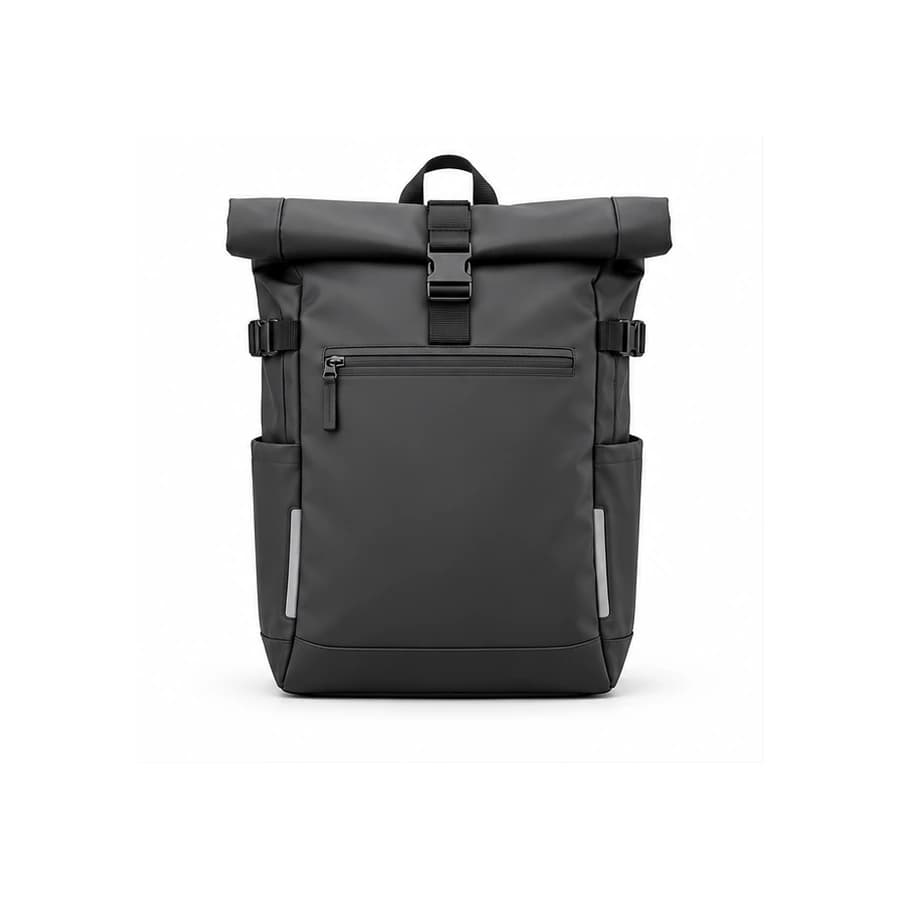
To choose branded backpacks for your business, start with the use: laptop and daily commutes, travel or events. Then compare the capacity, compartments, materials, branding area and minimum order of each model. Ask for a digital proof of the logo before production and confirm the lead time in the quote, which also states the estimated carbon footprint of each product.
Why the backpack is the corporate gift that gets used five days a week
Related catalogue product: Commute Roll-Top Backpack.
A company T-shirt is worn on one particular day. A notebook gets filled and filed away. A branded backpack, on the other hand, is one of the few merchandise items that enters the daily routine of whoever receives it: it goes to work, to the client's meeting room, to the airport for the business trip. Each of those journeys is a free brand impression, and it is the reason the backpack often tops the corporate gifts budget once a company starts thinking beyond the mug and the pen. You can see the models and their minimums in the catalogue of branded backpacks.
The problem is the same as with any technical item: "branded backpack" covers everything from a thin polyester bag that splits at the seam after three months to a model with a padded laptop compartment designed to last for years. Choosing badly does not save money, it just moves the cost into the recipient's bin.
What separates a serious corporate backpack from a generic trade-show one
The fabric and its real water resistance
600D (denier) polyester or higher, or an equivalent recycled ripstop, are the materials that hold up to daily use outdoors, not just inside a climate-controlled office. Below that density the fabric cracks and loses its water resistance after a few washes or exposures to rain. The denier figure almost never appears on the sales sheet the supplier shows you, so you have to ask for it explicitly before approving the order.
The strap stitching, not the logo embroidery
The point where a cheap backpack almost always fails is the join between the strap and the main body. A simple seam gives way within weeks if the backpack carries a laptop and a folder every day; a reinforcement with a rivet or cross-stitching lasts several years of real use. Before you confirm the order, ask the supplier for a close-up photo of that join, not just an image of the embroidered logo on the front flap.
The laptop compartment, with exact measurements
A padded "laptop" compartment with no specific measurement is an empty promise: some models take up to 13 inches and stop there. If the aim is for the team or clients to use the backpack as a real work bag, confirm the exact interior measurement in centimetres, not just the generic "laptop compartment" label.
Advertised capacity versus usable capacity
The litres the manufacturer advertises are calculated with the backpack empty and without rigid compartments. In real use, with a laptop, a bottle and a folder, the usable capacity falls by between 20% and 30%. For a welcome kit or a client gift, it is better to ask for the exact exterior measurements than to trust a round number of litres.
Branding: embroidery versus screen printing depending on the fabric
Embroidery stands up better to daily wear and is the default option for small logos on nylon or thick polyester, but it loses definition below a certain letter size. Textile screen printing covers larger surfaces and reproduces flat colours more faithfully, although on technical fabrics with water repellency it needs a specific ink or it cracks over time. For large front panels with the company's full logo, screen printing usually wins; for a discreet logo on the top flap, embroidery is the option that degrades least with washing.
As a quick reference, this is how the most common fabrics usually behave in a corporate backpack:
| Fabric | Water resistance | Best branding technique | Recommended use |
|---|---|---|---|
| 600D polyester | High | Embroidery | Daily use, office and commuting |
| Recycled ripstop | Medium to high | Screen printing | Events, trade shows, outdoors |
| Technical nylon | Very high | Embroidery | Business travel, adverse weather |
| Lightweight polyester (under 300D) | Low | None recommended | Avoid for continued corporate use |
Where the backpack fits within a corporate gifts programme
The backpack does not work equally well in every scenario. These are the ones where it performs best:
- Onboarding new staff: as the centrepiece of an employee welcome pack, replacing or accompanying the sweatshirt.
- Events and trade shows: as a gift the attendee carries away from the venue, with more visible surface than a tote bag. It suits programmes designed for events and conferences (see our use cases).
- Hybrid and remote teams: as part of the initial shipment to someone who works partly away from the office and needs to carry the company laptop.
- High-value client gift: in small orders with discreet branding, when the aim is for the recipient to use it outside the corporate context, not just inside the office.
The most expensive mistake: ordering the wrong one-size
Unlike a T-shirt, a "one size" backpack that is wrongly sized cannot be swapped for another size: either the company's standard laptop fits, or it does not. The usual mistake is approving the order based on a product photo without checking the interior measurements against the laptop model the team actually uses. If the company has a mixed fleet of equipment (13 and 15 inches, for example), it is better to order the largest compartment available than to risk some of the recipients being unable to use it for its main purpose.
Recycled materials without losing strength
Third-party certified recycled polyester from PET bottles (rPET) already matches the strength of the equivalent virgin fabric in most corporate backpack models, with the added advantage of a verifiable sustainability message compared with generic certifications. For companies with ESG criteria in their purchasing, ask the supplier for the recycling certificate, not just the "eco-friendly" label in the description. It is the same criterion we apply across the rest of the catalogue; see our sustainability page.
How much to order and how far in advance
Standard production for branded backpacks is 10 to 20 working days after you approve the proof, confirmed per order in the quote, plus shipping time. For a scheduled induction or an event with a fixed date, book production with a comfortable margin so there is room to review the proof and for transport.
A well-chosen corporate backpack is not the cheapest per unit: it is the one the recipient is still using after the first month, because that is what determines how many times the logo goes round the streets.
How we do it at Zintora
We start from the real use, not from the catalogue:
- We confirm how many units you need and for which scenario (onboarding, event, client).
- We show you the range of fabrics and compartments available with the exact measurements, not just in litres.
- We settle the branding: embroidery for durability, screen printing for large colour surfaces.
- We confirm production lead times before you confirm the quantity.
If you already know how many backpacks you need and for what date, you can request a quote directly, or first review the rest of the corporate merchandise catalogue, including our guide to printed tote bags for business, the other "daily carry" article that we often combine with the backpack in welcome kits.