How to choose custom flags for your business: formats, printing and buying
A practical guide to choosing custom flags for a business, shop, event or trade show by location, format, artwork file, finishes and lead time.
By Zintora Team
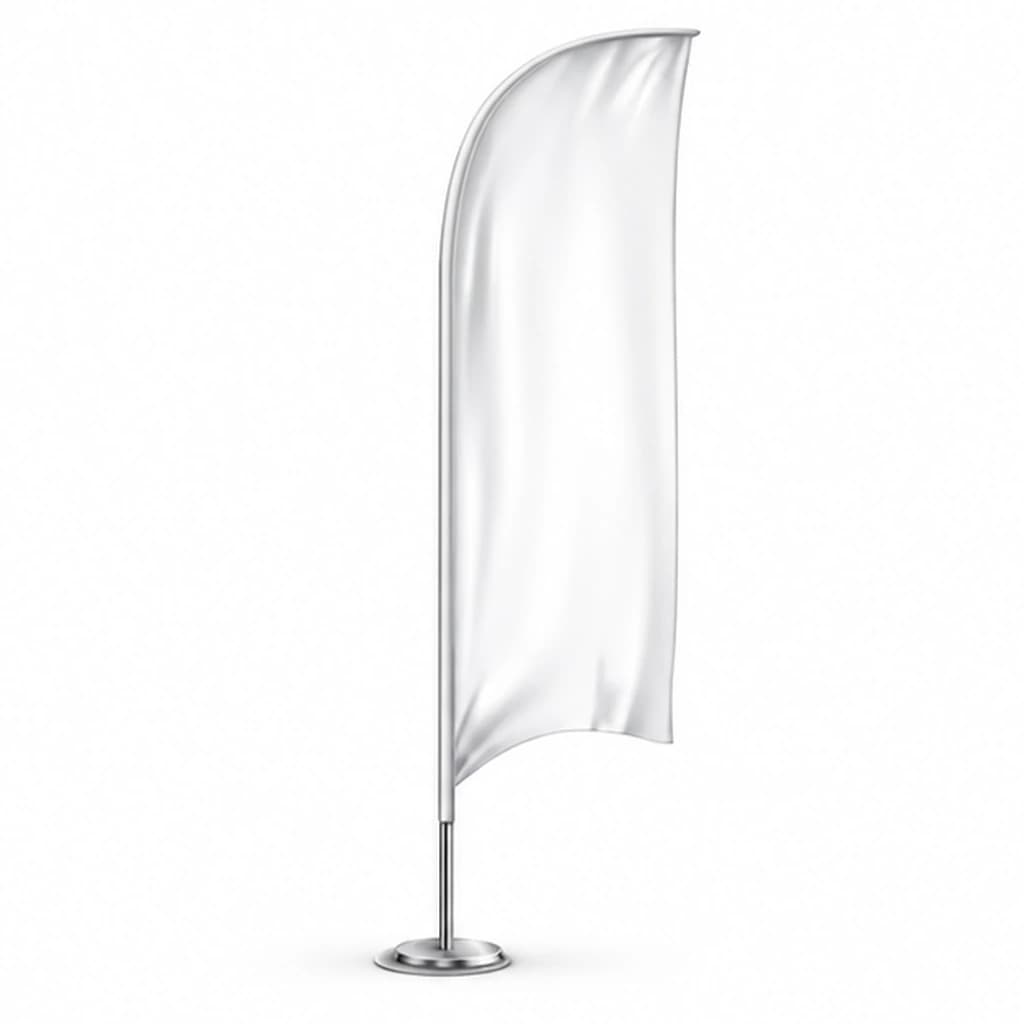
Custom flags turn a building frontage, a stand or a reception area into a visible brand point without taking up useful floor space. To make them work, choose the format from the place where it will be installed: an outdoor flag has to cope with wind, orientation and a fixing system; a tabletop piece has to keep its scale and legibility at close range.
Related catalogue product: Curved flag.
What type of flag does your business need?
| Use | Format worth considering | Key question |
|---|---|---|
| Entrance or frontage | Outdoor, vertical or hanging flag | How is it fixed and where will it be seen from? |
| Trade show or conference | Curved or vertical flag with a base | Does it fit the stand and travel well? |
| Reception or meeting room | Tabletop or satin flag | Does it need to be seen from one side or both? |
| Wall decoration | Wall or hanging flag | What finish does the edge need? |
| Campaign or event | Portable, repeatable format | How many sites need to use the same artwork? |
A bigger flag does not always give more visibility. If it ends up behind furniture, too close to the public or outside the line of passing traffic, part of the print is lost. Before ordering, measure the space, photograph the surroundings and note the normal reading distance.
Promotional flags for indoors and outdoors
Indoors you can prioritise drape, detail and presentation. Outdoors, the stability of the support, exposure to wind, rain and sunlight, and how often it is used weigh more. No fabric keeps the same appearance for ever in the open air: ask the supplier for installation, cleaning and replacement instructions, and avoid promises about lifespan that come without conditions of use.
If the flag will move between events, also confirm the folded size, the weight of the support and whether spare parts can be ordered separately. A solution that is easy to assemble reduces mistakes and saves buying a new structure when only the graphic needs updating.
Printing, colour and reading from a distance
Dye sublimation is often used on polyester fabrics, but the final technique depends on the material, the format and the visual result required. Ask for a digital proof showing proportions, orientation and a safety margin. Fine details, gradients and small text need to be checked at real scale, not only on an enlarged screen.
For a corporate logo, prepare a vector file as PDF, SVG or EPS. Convert fonts to outlines or include the licensed fonts. If your brand colour is critical, give the Pantone or CMYK references and ask how they will be checked in production. A computer screen is not a reliable colour proof for fabric.
Finishes to confirm
The same design may need a pole pocket, tape, eyelets, snap hooks, a hem or a reinforced edge depending on the support. Confirm in writing:
- finished dimensions and orientation;
- fixing system and which side the pole enters;
- one-sided or two-sided printing and how the reverse looks;
- reinforcement of the corners and edges;
- support, base or pole included;
- packaging per unit if the flags are distributed between sites;
- spare parts available for future campaigns.
Quantity and lead time
Minimum quantities and indicative lead times are set per product and shown on each product page, and the quote confirms them for your model, marking and approval date. Standard production is 10 to 20 working days after proof approval, confirmed per order in the quote. For openings, trade shows or campaigns with a fixed day, add margin for the proof, artwork changes and transport. The lead time should be counted from final approval of the design, not from the first email.
Grouping identical sizes and finishes simplifies production. If several sites use the same format with different names, supply a clear table linking file, quantity and destination. That cuts confusion without turning every variant into a separate project.
Checklist before requesting a quote
- Place of use and photographs of the space.
- Maximum dimensions and reading distance.
- Format and orientation.
- Vector file and colour references.
- Fixing system available.
- Quantity per design and per destination.
- Real deadline.
- Need for a sample or physical proof.
- Packaging and replenishment requirements.
Compare models and minimums on each flag's product page, explore the available formats in the catalogue and request a quote with location, quantity, dimensions and date. For giveaways to go with your flags, see our branded merchandise and corporate gifts pages, and read our guide to event and trade show merchandise. We will confirm the configuration and the print proof before production.